




Vous pensez qu'il y a une erreur sur ce lieu ?
Signaler une erreur
Vos retours sont importants pour nous. Si vous avez remarqué une erreur concernant ce lieu, merci de nous en informer pour que nous puissions la corriger.
Propriétaire de ce lieu ?
Nous récupérons automatiquement les informations disponibles sur votre lieu. Si jamais celles-ci ne sont pas correctes, connectez-vous gratuitement sur notre tableau de bord pour les modifier et bonus, accédez à vos statistiques détaillées.
 Modifier les informations de votre lieu
Ce qu'en disent les utilisateurs
Approuvé par 3 partenaires officiels


Falstaff Restaurants
@falstaff_restaurants
41followers
32119places
"Adresse répertoriée par Falstaff — Restaurant."

CROISIÈRE SUR LA VOLGA
@petitfute
4followers
215places
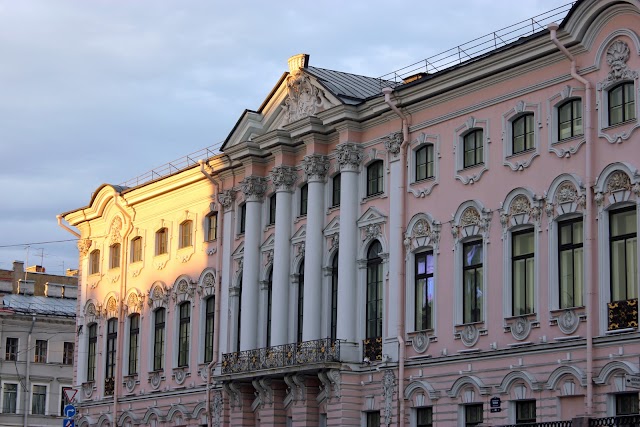
"Ce modèle réduit du palais d'Hiver est édifié pour la famille aristocratique des Stroganov par l'architecte Rastrelli, celui-là même qui entreprend, à peu près à la même époque, la construction du palais d'Hiver. Le palais Stroganov sera terminé, on s'en doute, bien plus tôt, en 1754. Marquant l'angle de la perspective Nevsky et du canal de la Moïka, sa façade rose perle flanquée d'une volée de colonnes et de frontons blancs rehaussés de liserés couleur bronze, offre un avant-goût élégamment baroque du palais d'Hiver. Mais pour ce qui concerne la riche collection d'oeuvres d'art rassemblée par les Stroganov - qui ont donné des ministres et des mécènes à l'empire, A. Stroganov a été le président de l'Académie des beaux-arts - elle est allée enrichir le musée de l'Ermitage. Autre legs de cette prestigieuse famille à la Russie, le fameux boeuf Stroganov ou Stroganoff, grand plaisir des palais russes... Ce sont des expériences autres que culinaires qui se feront derrière les murs du palais après la révolution d'Octobre, puisqu'il abritera dès lors un institut de recherches. À la chute de l'Union soviétique, le Palais est rattaché au Musée russe (1991). Le palais Stroganov retrouve dès lors et enfin un propriétaire plus proche des préoccupations artistiques de ses premiers occupants. Restauré à l'occasion du 300 e anniversaire de Saint-Pétersbourg, le palais s'est encore enrichi de sept salles dédiées à la porcelaine impériale, en provenance des fabriques de Lomonossov."

La Passion des Chateaux
@passionchateau
8467followers
1472places
Autres lieux à voir autour
 Musée de l'Ermitage
Palace Square, 2, St Petersburg, Russie, 190000
Ajouté par611 utilisateurs
Musée de l'Ermitage
Palace Square, 2, St Petersburg, Russie, 190000
Ajouté par611 utilisateurs
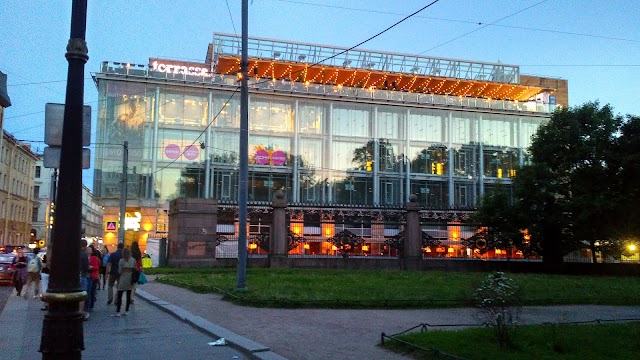 Terrassa
Kazanskaya ul., 3, St Petersburg, Russie, 191186
Ajouté par120 utilisateurs
Terrassa
Kazanskaya ul., 3, St Petersburg, Russie, 191186
Ajouté par120 utilisateurs
 Cathédrale Saint-Sauveur-sur-le-Sang-Versé de Saint-Pétersbourg
Griboyedov Canal Embankment, 2Б, St Petersburg, Russie, 191186
Ajouté par398 utilisateurs
Cathédrale Saint-Sauveur-sur-le-Sang-Versé de Saint-Pétersbourg
Griboyedov Canal Embankment, 2Б, St Petersburg, Russie, 191186
Ajouté par398 utilisateurs
 Percorso
Voznesensky Ave, 1/2, отель "Four seasons", St Petersburg, Russie, 190000
Ajouté par46 utilisateurs
Percorso
Voznesensky Ave, 1/2, отель "Four seasons", St Petersburg, Russie, 190000
Ajouté par46 utilisateurs
 SO Sofitel St. Petersburg
Voznesensky Ave, 6, Sankt-Peterburg, Leningrad Oblast, Russie, 190000
Ajouté par44 utilisateurs
SO Sofitel St. Petersburg
Voznesensky Ave, 6, Sankt-Peterburg, Leningrad Oblast, Russie, 190000
Ajouté par44 utilisateurs
 Cococo
Voznesensky Ave, 6, Sankt-Peterburg, Russie, 190000
Ajouté par241 utilisateurs
Cococo
Voznesensky Ave, 6, Sankt-Peterburg, Russie, 190000
Ajouté par241 utilisateurs
 Winter Palace
Palace Embankment, 32, St Petersburg, Russie, 190000
Ajouté par128 utilisateurs
Winter Palace
Palace Embankment, 32, St Petersburg, Russie, 190000
Ajouté par128 utilisateurs
 Marketplace
Nevsky avenue, 24, Sankt-Peterburg, Ленинградская область, Russie, 191186
Ajouté par112 utilisateurs
Marketplace
Nevsky avenue, 24, Sankt-Peterburg, Ленинградская область, Russie, 191186
Ajouté par112 utilisateurs
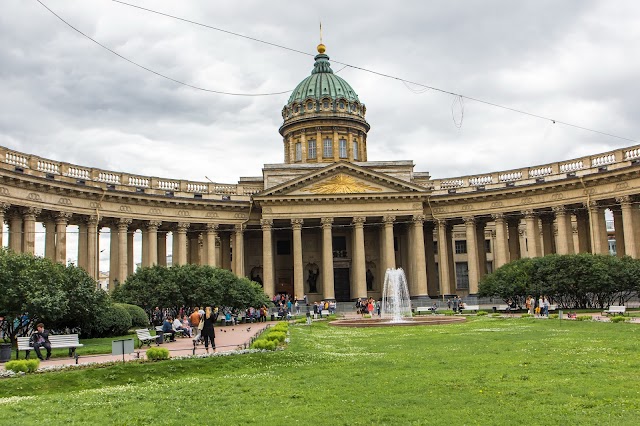 Kazan Cathedral
Kazan Square, 2, Sankt-Peterburg, Russie, 190000
Ajouté par116 utilisateurs
Kazan Cathedral
Kazan Square, 2, Sankt-Peterburg, Russie, 190000
Ajouté par116 utilisateurs
 Belmond Grand Hotel Europe
Mikhaylovskaya ul., 1/7, St Petersburg, Russie, 191186
Ajouté par103 utilisateurs
Belmond Grand Hotel Europe
Mikhaylovskaya ul., 1/7, St Petersburg, Russie, 191186
Ajouté par103 utilisateurs
"Late Baroque palace Built to Bartolomeo Rastrelli's designs for Baron Sergei Grigoriyevich Stroganov in 1753–1754 One of the oldest and finest of the aristocratic residences in St. Petersburg, the Stroganov Palace has a prominent location on the corner of Nevsky Prospekt and the Moika River Embankment, and now houses part of the collections of the State Russian Museum. The Stroganov family had been prominent merchants since the 15th century, but rose to the ranks of the aristocracy only in the reign of Peter the Great, when the family was ennobled in thanks for considerable financial assistance to the Tsar's armies in the Great Northern War. The family was brought to national prominence by Baron Sergey Griogoryevich Stroganov in the reign of Empress Elizabeth, and by his son Count Alexander Sergeevich Stroganov, who was a leading St. Petersburg administrator and ended his life as President of the Academy of Arts and Director of the Imperial Public Library. It was the former who commissioned the building of the Stroganov Palace from Francesco Bartolomeo Rastrelli in 1752. The exteriors that he created were completed in 1754, and remain intact to this day, one of the most prominent masterpieces of late Baroque in St. Petersburg. The most impressive interiors of the palace, however, are those created by Andrey Voronikhin, architect of the Kazan Cathedral, who was employed by Count Alexander Sergeevich in the 1790s and 1800s to remodel the interior decor in the neoclassical style (recent scholarship has contested that much of this work was done by Fyodor Demertsov). Many of these have now been restored and opened to the public as the State Rooms in the eastern enfilade of the building, among them the remarkably ornate Mineral Study, which housed Count Alexander's library and collection of precious stones and minerals, and the Picture Gallery, which was once home to his impressive art collection, including works by Rembrandt and Poussin. Restoration is ongoing in other parts of the palace. The Stroganov Palace was nationalized in 1918, and originally operated as a Museum of Aristocratic Life. This, however, was closed in 1929, and the exhibits were handed over to the Hermitage. Other artifacts from the palace were passed to other Soviet museums or sold abroad. From then on the palace served as offices for various Soviet enterprises, including a botanical institute and as a ship-building research facility."
@nchavotier