


Vous pensez qu'il y a une erreur sur ce lieu ?
Signaler une erreur
Vos retours sont importants pour nous. Si vous avez remarqué une erreur concernant ce lieu, merci de nous en informer pour que nous puissions la corriger.
Propriétaire de ce lieu ?
Nous récupérons automatiquement les informations disponibles sur votre lieu. Si jamais celles-ci ne sont pas correctes, connectez-vous gratuitement sur notre tableau de bord pour les modifier et bonus, accédez à vos statistiques détaillées.
 Modifier les informations de votre lieu
Ce qu'en disent les utilisateurs
Approuvé par 1 partenaires officiels


Autres lieux à voir autour
 Musée de l'Ermitage
Palace Square, 2, St Petersburg, Russie, 190000
Ajouté par611 utilisateurs
 El Copitas
Kolokolnaya ul., 2, Sankt-Peterburg, Ленинградская область, Russie, 191025
Ajouté par145 utilisateurs
 BIRCH
Kirochnaya Ulitsa, 3, Sankt-Peterburg, Russie, 191028
Ajouté par143 utilisateurs
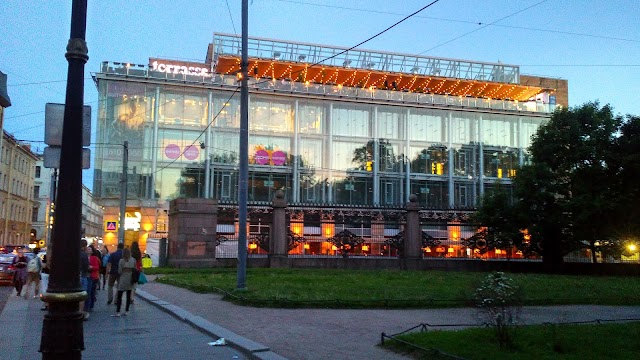 Terrassa
Kazanskaya ul., 3, St Petersburg, Russie, 191186
Ajouté par120 utilisateurs
 Harvest
Prospekt Dobrolyubova, 11, Sankt-Peterburg, Russie, 197198
Ajouté par99 utilisateurs
 Cathédrale Saint-Sauveur-sur-le-Sang-Versé de Saint-Pétersbourg
Griboyedov Canal Embankment, 2Б, St Petersburg, Russie, 191186
Ajouté par399 utilisateurs
 Банщики
Degtyarnaya ul., 1А, Sankt-Peterburg, Russie, 191024
Ajouté par53 utilisateurs
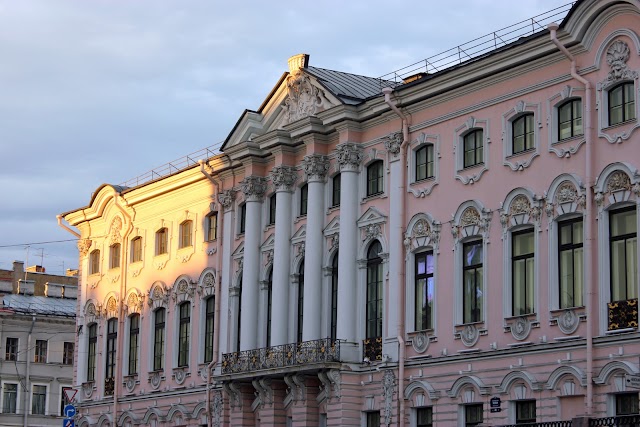 Palais Stroganov
Nevsky Prospect, 17, St Petersburg, Russie, 197101
Ajouté par27 utilisateurs
 Cathédrale Saint-Isaac
St Isaac's Square, 4, St Petersburg, Russie, 190000
Ajouté par282 utilisateurs
 Théâtre Mariinsky
Theatre Square, 1, St Petersburg, Russie, 190000
Ajouté par174 utilisateurs
"UNESCO World Heritage When Catherine the Great ordered a grand garden in the English style at Pavlovsk, wild and forested hunting grounds were transformed into a formal park in the finest English stately home tradition, dotted with Greek temples, classical bridges, and statues. The 1,300-acre (600 ha) sanctuary was the inspired work of Catherine's pet architect, Scotsman Charles Cameron. He outlined the general layout of the park and designed several pavilions, including the Temple of Friendship, a large domed rotunda with Doric columns. However, the Scotsman's signature design was the elegant three-storied rectangular gold and white palace, crowned by a flat dome or cupola on sixty-four columns, in the style of the Pantheon. Catherine presented the estate to her unloved son Paul on the birth of his first child, and Pavlovsk became his summer palace. Cameron never had the same free hand in the service of Paul I and his wife, Grand Duchess Maria Feodorovna. The latter was a gardening fanatic and had plants shipped over from London's Kew Gardens. Scheming architects, notably Vincenzo Brenna, jostled for royal favor, pushing Cameron aside. The palace's semicircular wing-colonnades are Brenna's work and are reminiscent of Palladian villas. Maria Feodorovna's influence is also discernible in the exquisitely furnished interiors, such as the Grecian Hall. Together with a succession of architects (including Andrei Voronikhin and Carlo Rossi) as well as painters and sculptors, she created exquisite set pieces comprising paintings, textiles, sculptures, Sevres porcelain, crystal glass, and chandeliers, all set in marble and colored stucco. The formation of the Pavlovsk complex took place while Russia was dominant in Europe. The ensemble-which was virtually rebuilt after Nazi occupation-reflects the spirit of the age of absolute monarchs."
@nchavotier