


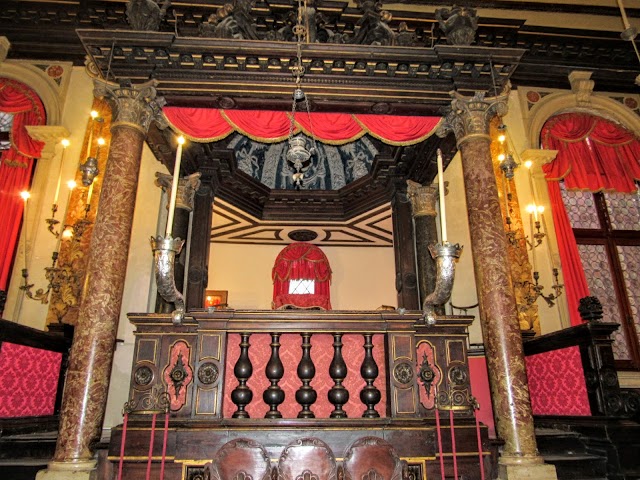


Visite du Campo del Ghetto Novo à Venise, un monument historique
Le Campo del Ghetto Novo, situé dans le quartier de Cannaregio à Venise, est un monument emblématique de l'histoire juive en Europe. Fondé en 1516, ce quartier juif a été créé pour isoler la communauté juive de la ville, devenant un lieu chargé d'histoire et de mémoire. À travers les siècles, il a connu plusieurs extensions, notamment dans le Ghetto Vecchio, et a été témoin de nombreux événements, dont la persécution durant la Seconde Guerre mondiale. Aujourd'hui, il reste un site incontournable pour une visite enrichissante, offrant un aperçu précieux de l'architecture et de la vie quotidienne de l'époque. Le site est idéal pour une ballade, mêlant histoire, architecture et patrimoine culturel, et constitue un point d'intérêt majeur à voir lors de votre séjour à Venise.
Le quartier se distingue par ses synagogues remarquables, notamment la Schola Canton, la Schola Tedesca, ainsi que la Schola Italiana, qui illustrent la diversité culturelle et architecturale de la communauté juive. La place elle-même, avec ses pavés gravés commémoratifs de la Shoah, invite à la réflexion. L'ambiance y est calme et respectueuse, parfaite pour une promenade contemplative. La visite du Ghetto offre une immersion dans un lieu chargé d'histoire, où chaque pierre raconte un récit de résilience et de mémoire, faisant du Campo del Ghetto Novo un lieu à voir absolument lors d'une balade à Venise.
Vos retours sont importants pour nous. Si vous avez remarqué une erreur concernant ce lieu, merci de nous en informer pour que nous puissions la corriger.
Nous récupérons automatiquement les informations disponibles sur votre lieu. Si jamais celles-ci ne sont pas correctes, connectez-vous gratuitement sur notre tableau de bord pour les modifier et bonus, accédez à vos statistiques détaillées.
 Modifier les informations de votre lieu


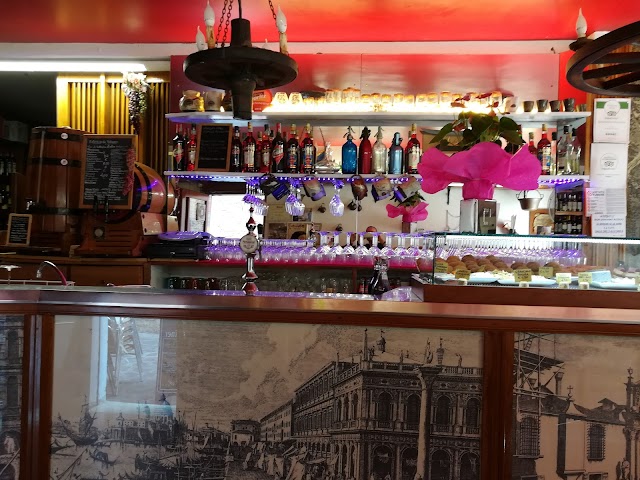 Vino Vero
Fondamenta Misericordia, 2497, 30100 Venezia, Italie
Ajouté par3909 utilisateurs
Vino Vero
Fondamenta Misericordia, 2497, 30100 Venezia, Italie
Ajouté par3909 utilisateurs
 Paradiso
 perduto, 30100 Venezia, Italie
Ajouté par4337 utilisateurs
Paradiso
Paradiso perduto, 30100 Venezia, Italie
Ajouté par4337 utilisateurs
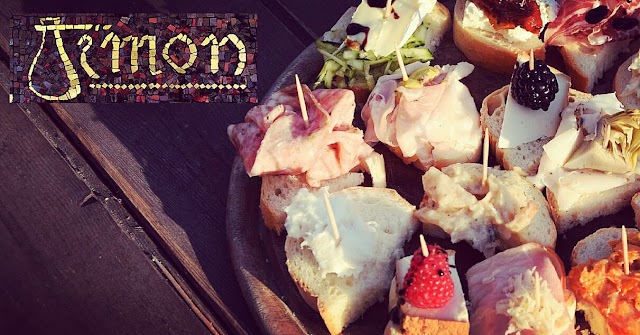 Al Timon
Fondamenta Ormesini, 2754, Venezia, Italie
Ajouté par3955 utilisateurs
Al Timon
Fondamenta Ormesini, 2754, Venezia, Italie
Ajouté par3955 utilisateurs
 Osteria Anice Stellato
Fondamenta de la Sensa, 3272, 30121 Venezia VE, Italie
Ajouté par2241 utilisateurs
Osteria Anice Stellato
Fondamenta de la Sensa, 3272, 30121 Venezia VE, Italie
Ajouté par2241 utilisateurs
 Torrefazione Cannaregio
Fondamenta dei Ormesini, 2804, 30121 Venezia VE, Italie
Ajouté par1511 utilisateurs
Torrefazione Cannaregio
Fondamenta dei Ormesini, 2804, 30121 Venezia VE, Italie
Ajouté par1511 utilisateurs
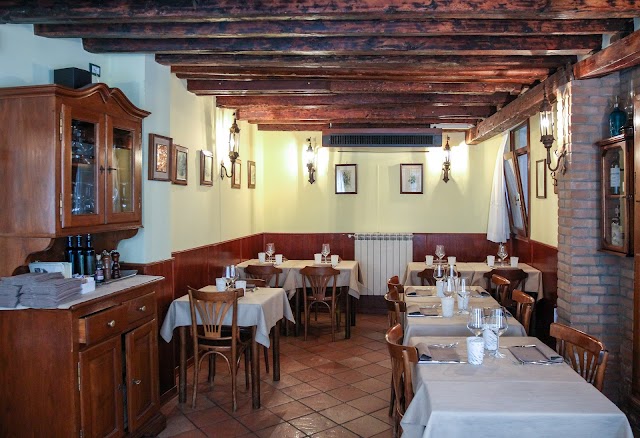 Vini da Gigio
Sestiere, Calle Stua Cannaregio, 3628A, 30121 Venezia VE, Italie
Ajouté par1304 utilisateurs
Vini da Gigio
Sestiere, Calle Stua Cannaregio, 3628A, 30121 Venezia VE, Italie
Ajouté par1304 utilisateurs
 sullaluna
2535, Fondamenta Misericordia, 30121 Venezia VE, Italie
Ajouté par1288 utilisateurs
sullaluna
2535, Fondamenta Misericordia, 30121 Venezia VE, Italie
Ajouté par1288 utilisateurs
 Trattoria dalla Marisa
Cannaregio, 652, 30171 Venezia, Italie
Ajouté par1085 utilisateurs
Trattoria dalla Marisa
Cannaregio, 652, 30171 Venezia, Italie
Ajouté par1085 utilisateurs
 Cantina aziende agricole Roberto Berti
Rio Terà Farsetti, 1847/a, Sestiere Cannaregio, Venezia VE, Italie
Ajouté par610 utilisateurs
Cantina aziende agricole Roberto Berti
Rio Terà Farsetti, 1847/a, Sestiere Cannaregio, Venezia VE, Italie
Ajouté par610 utilisateurs
 Trattoria Bar Pontini
Fondamenta Cannaregio, 1268, 30121 Venezia, Italie
Ajouté par728 utilisateurs
Trattoria Bar Pontini
Fondamenta Cannaregio, 1268, 30121 Venezia, Italie
Ajouté par728 utilisateurs
"In medieval times this part of Cannaregio housed a getto (foundry), but it was as the designated Jewish quarter from the 16th to 19th centuries that the word acquired a whole new meaning. In accordance with the Venetian Republic’s 1516 decree, by day Jewish lenders, doctors and clothing merchants were permitted to attend to Venice's commercial interests, but at night and on Christian holidays they were locked within the gated island of the Ghetto Nuovo (New Foundry). When Jewish merchants fled the Spanish Inquisition for Venice in 1541, there was no place left in the Ghetto to go but up: in buildings around the Campo del Ghetto Nuovo, upper storeys housed new arrivals, synagogues and publishing houses. A plain wooden cupola in the corner of the campo (square) marks the location of the Schola Canton. Next door is the Schola Tedesca, while the rooftop Schola Italiana is a simple synagogue built by newly arrived and largely destitute Italian Jews, who had fled from Spanish-controlled southern Italy. As numbers grew, the Ghetto was extended into the neighbouring Ghetto Vecchio (Old Foundry), creating the confusing situation where the older Jewish area is called the New Ghetto and the newer is the Old Ghetto. Sephardic Jewish refugees raised two synagogues in Campo del Ghetto Vecchio that are considered among the most beautiful in northern Italy, lavishly rebuilt in the 17th century. The Schola Levantina, founded in 1541, has a magnificent 17th-century woodworked pulpit, while the Schola Spagnola, founded around 1580, shows just how Venetian the community had become through a demonstrated flair for Venetian architectural flourishes: repeating geometric details, high-arched windows, and exuberant marble and carved-wood baroque interiors. After Venice fell to Napoleon in 1787 the city's Jews experienced six months of freedom before the Austrian administration restricted them to the Ghetto once again. It wasn't until Venice joined with Italy in 1866 that full emancipation was gained, but even that was short-lived. Many of Venice's Jews fled before the Nazi occupation, but 246 were arrested and sent to concentration camps between 1943 and 1944; only eight survived. A memorial consisting of harrowing bas-reliefs and the names and ages of those killed now lines two walls facing Campo del Ghetto Nuovo. You can stroll around this peaceful precinct by day and night, but the best way to experience the Ghetto is on a guided tour of three of the synagogues offered by the Museo Ebraico, departing hourly from 10.30am."
@
"Yonder Quartier juif Plus ancien ghetto d’Europe "
@mguerillot38
"point de rencontre pour la Gondoliere , il y a un petit banc. apporter de l'argent liquide ces préférable "
@ericdumaine
"Belle place Fait le 03/12 /22"
@
"Quartier juif avec ghetto et musée dans le quartier de Cannaregio"
@
"voir les 5 pavés gravés commémoratifs shoah"
@
"Tour de gondole dans ce quartier calme super expérience ! "
@chizon
"plus à voir, mais ghetto pour les juifs. Le mot "ghetto" est vénitien d'ailleurs. "
@
"Fondato all’inizio del XVI secolo, il ghetto di Venezia è stato uno dei primi posti al mondo a segregare forzatamente le persone in base alla loro differenza religiosa. Durante il suo massimo splendore nel corso del 17 ° secolo, 5.000 ebrei provenienti da tutta Europa vivevano all’interno dell’area del ghetto. L’area veniva precedentemente utilizzata come fonderia (che è “getto” nel dialetto veneziano), è proprio da qui che è nato il termine “ghetto”. Vale la pena visitare questa zona per saperne di più sulla storia e su come si è evoluta nel corso degli anni."
@alice.corrado
"Tour de gondoles dans le quartier historique du ghetto avec la gondolière Chiara. https://g.co/kgs/kaL2h8"
@
"Juif / restaurant gam gam "
@
"Ancien ghetto juif - place sympa"
@