


Musée de Djémila


Vous pensez qu'il y a une erreur sur ce lieu ?
Signaler une erreur
Vos retours sont importants pour nous. Si vous avez remarqué une erreur concernant ce lieu, merci de nous en informer pour que nous puissions la corriger.
Propriétaire de ce lieu ?
Nous récupérons automatiquement les informations disponibles sur votre lieu. Si jamais celles-ci ne sont pas correctes, connectez-vous gratuitement sur notre tableau de bord pour les modifier et bonus, accédez à vos statistiques détaillées.
 Modifier les informations de votre lieu
Ce qu'en disent les utilisateurs
Approuvé par 1 partenaires officiels


Autres lieux à voir autour
 Kalâa des Béni Hammad
Maadid, Algérie
Ajouté par19 utilisateurs
Kalâa des Béni Hammad
Maadid, Algérie
Ajouté par19 utilisateurs
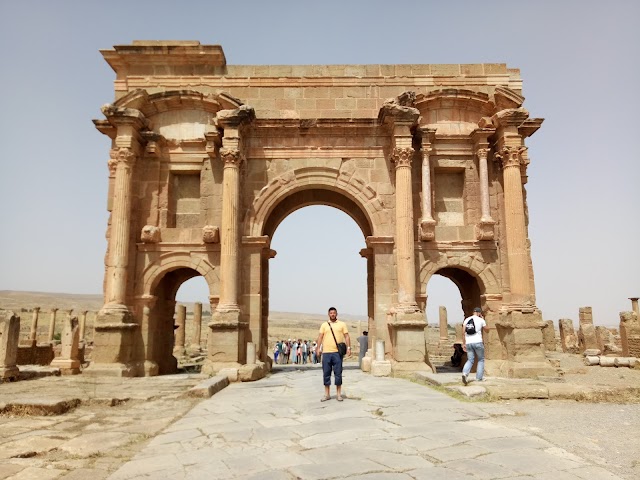 Ruines Romaines Timgad
Timgad, Algérie
Ajouté par26 utilisateurs
Ruines Romaines Timgad
Timgad, Algérie
Ajouté par26 utilisateurs
 Timgad
, Algérie
Ajouté par23 utilisateurs
Timgad
Timgad, Algérie
Ajouté par23 utilisateurs
 Park Mall Setif
Rue du 8 November, Sétif, Algérie
Ajouté par19 utilisateurs
Park Mall Setif
Rue du 8 November, Sétif, Algérie
Ajouté par19 utilisateurs
 Restaurant Igherssan
Rue Larbi Ben M'Hidi, Constantine, Algeria
Ajouté par14 utilisateurs
Restaurant Igherssan
Rue Larbi Ben M'Hidi, Constantine, Algeria
Ajouté par14 utilisateurs
 Constantine
, Algérie
Ajouté par13 utilisateurs
Constantine
Constantine, Algérie
Ajouté par13 utilisateurs
 Auberge Le Thaïs
Toudja 06340, Algérie
Ajouté par14 utilisateurs
Auberge Le Thaïs
Toudja 06340, Algérie
Ajouté par14 utilisateurs
 Mosquée Emir Abdelkader
Rue Filali, Constantine, Algérie
Ajouté par11 utilisateurs
Mosquée Emir Abdelkader
Rue Filali, Constantine, Algérie
Ajouté par11 utilisateurs
 Timgad
تيمقاد Algeria
Ajouté par11 utilisateurs
Timgad
تيمقاد Algeria
Ajouté par11 utilisateurs
 Djemila
, Algérie
Ajouté par10 utilisateurs
Djemila
Djemila, Algérie
Ajouté par10 utilisateurs
"Best visited before the ruins ⚠️ At quiet times, the museum might be kept locked, but it will be opened if you ask at the main entrance to the site Contains many of the wonders dug out of the ground here but the real highlight are the extraordinary number of beautiful mosaics (around 1700 sq metres of them, which together cover all the floors and walls of the museum). Among their number are some considered to be among the finest yet found in North Africa ❇️ Outside the museum building there are many tombstones and other funerary sculptures, the outer walls lined with mosaics salvaged from the site, the covered court housing busts of the emperor Septimus Severus and his wife, Julia Domna. The mosaics lining most of the interior walls are hugely impressive. Highlights include a mosaic showing a hunting scene; the 10m-long so-called Mosaic of the Donkey, which shows a range of local animals; and the inscription of Bishop Cressonius, a statement of faith lifted from the floor of the South Basilica. The masterpiece – one of the greatest North African mosaics – is of the Legend of Dionysos, brought from the House of Bacchus and now in the third hall. The mosaic shows four scenes in the legend of Dionysos: being nursed by the nymph Nysa; being carried on a tiger; an offering made at a cult festival in winter; and an initiation scene during which a woman turns her head from a phallus. The mosaic’s central panel shows another scene from the Dionysos myth in which the nymph Ambrosia is murdered by King Lycurgus. The design and execution suggest the level of sophistication achieved in ancient Djemila. Also in this last room is a 4th- to 5th-century mosaic of men on foot and horse, hunting lion, boar and panther – note the kneeling hunter levelling his spear at a leaping lion."
@nchavotier
"Ruines de cette ancienne cité romaine."
@histoireitinerante