


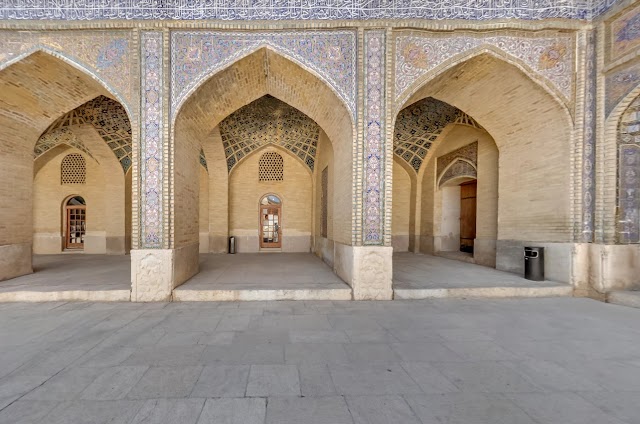


Mosquée Nasir-ol-Molk : joyau d'architecture iranienne
Fondée à la fin du XIXe siècle, la Mosquée Nasir-ol-Molk a été commandée par Mirza Hasan Ali Nasir al-Mulk, un noble de la dynastie Qajar, à Shiraz, dans la province de Fars, en Iran. Conçue par les architectes Mohammad Hasan-e-Memar et Mohammad Reza Kashi-Saz, cette mosquée est un exemple remarquable de l'architecture islamique et persane, mêlant styles traditionnels et innovations artistiques. Elle est aujourd'hui reconnue comme un monument historique d'exception, souvent citée comme une alternative aux merveilles du monde. La mosquée se distingue par ses vitraux colorés, ses mosaïques élaborées et ses détails architecturaux sophistiqués, qui en font un lieu de visite incontournable pour les amateurs d’histoire et d’art. La lumière qui filtre à travers les vitraux crée un spectacle de couleurs, notamment dans la tonalité rose qui lui vaut son surnom, la mosquée rose. La richesse de ses décorations et la finesse de ses motifs en font un monument religieux d'une beauté rare, illustrant la splendeur de l'architecture iranienne. Son ambiance intérieure, empreinte de sérénité, invite à la contemplation et à la découverte de l’art islamique traditionnel.
Vos retours sont importants pour nous. Si vous avez remarqué une erreur concernant ce lieu, merci de nous en informer pour que nous puissions la corriger.
Nous récupérons automatiquement les informations disponibles sur votre lieu. Si jamais celles-ci ne sont pas correctes, connectez-vous gratuitement sur notre tableau de bord pour les modifier et bonus, accédez à vos statistiques détaillées.
 Modifier les informations de votre lieu


 Persépolis
Iran
Ajouté par82 utilisateurs
Persépolis
Iran
Ajouté par82 utilisateurs
 Shahcheragh
District 8, Shiraz, Fars Province, Iran
Ajouté par35 utilisateurs
Shahcheragh
District 8, Shiraz, Fars Province, Iran
Ajouté par35 utilisateurs
 Haft Khan International Restaurant
Fars Province, Shiraz, Ayatollah Rabbani Blvd, No. 17, Iran
Ajouté par30 utilisateurs
Haft Khan International Restaurant
Fars Province, Shiraz, Ayatollah Rabbani Blvd, No. 17, Iran
Ajouté par30 utilisateurs
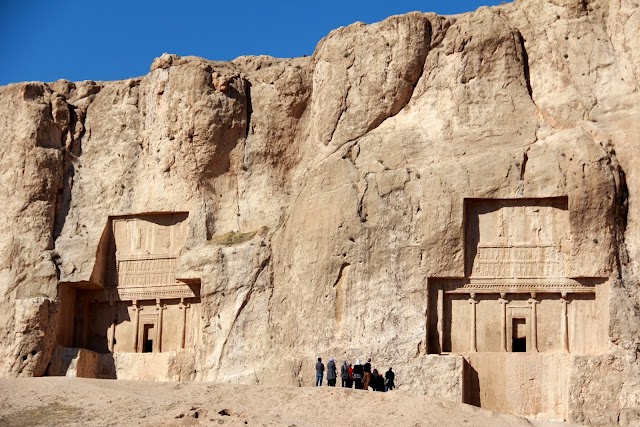 Naqsh-e Rustam
Fars, Iran
Ajouté par22 utilisateurs
Naqsh-e Rustam
Fars, Iran
Ajouté par22 utilisateurs
 Eram Garden
Shiraz, Fars, Iran
Ajouté par23 utilisateurs
Eram Garden
Shiraz, Fars, Iran
Ajouté par23 utilisateurs
 Mosquée Vakil
Fars Province, Shiraz, طالقانی، Iran
Ajouté par22 utilisateurs
Mosquée Vakil
Fars Province, Shiraz, طالقانی، Iran
Ajouté par22 utilisateurs
 Mausolée de Hafez
Fars Province, Shiraz, District 3, خیابان حافظیه، Iran
Ajouté par21 utilisateurs
Mausolée de Hafez
Fars Province, Shiraz, District 3, خیابان حافظیه، Iran
Ajouté par21 utilisateurs
 Naranjestan Qavam
Fars Province, Shiraz, Lotf Ali Khan Zand St, Iran
Ajouté par17 utilisateurs
Naranjestan Qavam
Fars Province, Shiraz, Lotf Ali Khan Zand St, Iran
Ajouté par17 utilisateurs
 Karim Khan Citadel
Fars Province, Shiraz, District 8, Zand, Iran
Ajouté par16 utilisateurs
Karim Khan Citadel
Fars Province, Shiraz, District 8, Zand, Iran
Ajouté par16 utilisateurs
 Niayesh Boutique Hotel
Fars Province, Shiraz, District 8, Alley No4، Dastgheib Blvd, 71398-56135, Iran
Ajouté par17 utilisateurs
Niayesh Boutique Hotel
Fars Province, Shiraz, District 8, Alley No4، Dastgheib Blvd, 71398-56135, Iran
Ajouté par17 utilisateurs
"https://www.instagram.com/reel/DL5DU7dSTiO/?igsh=a293dXd5YjV6Y3M=9 ft 10,11 in"
@lucanwak
"> A 19th-century mosque that, through its use of light and colour, is among the most stunning examples of Islamic art in the world The Nasir al-Mulk Mosque is also known as the Pink Mosque, the Mosque of Colours, and the Rainbow Mosque. It was built in Shiraz, Iran, on the orders of Mirza Hasan 'Ali Nasir al-Mulk, a member of the Qajar dynasty, which ruled Persia (Iran) from 1779 to 1925. Begun in 1876, the mosque was completed by 1888. Its layout is traditional for Islamic, and specifically Persian, architecture - two prayer halls face one another across a courtyard and are joined by a vaulted hall, known as an iwan, topped by two low minarets. The courtyard has a rectangular pool, which both cools the air and symbolizes ritual purification. Inner beauty The mosque's external decoration of intricately patterned pink, yellow, and blue ceramic tiles gives only a hint of the beauty of its interior. Determined to create a place of worship that reflected the relationship between Heaven and Earth, the mosque's two designers - Mohammad Hasan-e-Memar and Mohammad Reza Kashi-Saz-e-Sirazi - turned the interior into a space filled with jewel-like light and colour. As the morning Sun hits the stained-glass facade of the winter prayer hall, a kaleidoscope of colour spills onto its inner walls, which are covered from floor to ceiling in tiled, stuccoed, and painted designs. The three-dimensional and highly decorated mugarnas (see panel, below) and panj kaseh-l (the "five concave shapes") that adorn the ceiling domes create patterns of light and shade that add to the mosque's vibrant beauty. This ebullient use of colour is balanced by the simplicity of the building itself and the expert use of symmetry, repetitions, and geometry, typical of Islamic architecture, so that the mosque never feels overwhelming but remains a joyful and peaceful place."
@nchavotier
"Soprannominata la moschea rosa, al suo interno ci sono splendide geometrie. "
@ilaria.possenti
"Visit early for sunrise through windows"
@eriklaurens93